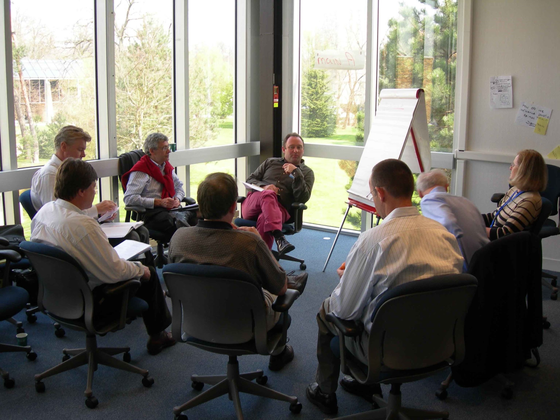
Pulse is the monthly working call where partners and associates of the GRLI connect the dots across a dispersed field – “scattered together”, as we say. Between the platform gatherings at EFMD, AACSB, PRME, the Academy of Management and the regional networks, Pulse is where we turn inward for 90 minutes and sense, together, what each of us is noticing. What follows is a selective reflection from our call of 22 July 2026, written with care: candid passages have been generalised, and nothing is published without sign-off from the room.
This was one of our APAC-friendly slots, and it showed in the geography. Darija hosted from Bali, arriving a little drained after three weeks of family and a run of World Cup matches that kicked off at three in the morning her time. John came in from a cold, wet George, back from a winter break in Namibia and now, by his own admission, fairly focused on the Tour de France. Anindo Bhattacharjee joined from a monsoon-bound Woxsen in India — weekend trips on hold, but “loving the solitude”. Wayne Visser was gearing up for his son’s wedding in Santa Barbara. Ying, at the University of Dundee, was taking no summer at all. And Patricija Zizyte of oikos International arrived honestly: “It’s always a crisis mode, to be honest.”
Darija opened by naming the frame she and John hold for these calls — the developmental arc of I, We, All of Us — and a single check-in question: what is alive for you, individually and institutionally, as you arrive?
What’s alive
A lot, as it turned out, and much of it rhyming. Wayne reminded us to look out for Católica Porto’s rebranding, to be unveiled on 1 September, alongside a new Executive MBA in AI and Sustainability still searching the globe for its third partner. Ying is rebuilding an MBA portfolio and deepening industry partnerships while her institution, University of Dundee, quietly reorganises schools into faculties. Anindo, now heading research at Woxsen, has been travelling hard: the RRBM meeting at Kozminski in Poland, the Academy of Management ahead, and a just-finished circular-economy project with a large German automotive group. Patricija, recently returned to Europe from her time travelling in Indonesia, carries oikos through a genuine funding squeeze.
The unmistakably human
Anindo brought back a live question from the RRBM gathering: not only how AI reshapes leadership, but how it reshapes the way we do research. “We cannot be completely oblivious to AI,” he said – and increasingly it belongs in the work, as a partner in the tedious parts, from literature review to testing whether an idea will land. The sharper question is what that does to authenticity and to the defensibility of ideas when human and machine intelligence work side by side. “Sometimes it’s very scary,” he admitted of how good the models have become.
John’s read was that this is exactly the pre-competitive terrain where GRLI is useful – making sure the learning from one network doesn’t stay sealed inside it while three others reinvent it in parallel. As he put it, if responsibility could be fully specified it would be compliance; what cannot be handed to a machine is the judgement to act well under uncertainty. The instinct to keep what is unmistakably human at the centre, it turned out, was pointing at the same thing.
The question that held the room: student voice
The thread that kept returning was students — and how rarely they are actually in the room in higher education spaces. Patricija named it most directly: GRLI spaces are rich with deans and programme directors comparing what programs they run, “but how about engaging students on globally responsible leadership, actually including them into conversation?” She wants meaningful participation rather than tokenism. She reminded the group of long lived oikos involvement in setting up various organizations, frameworks and programs known to everyone in the field — evidence of student-led capacity that already exists and needs to be built on. Due to the nature of student-led organizations, it gets increasingly harder to maintain their operations, especially, sustainable funding models.
Anindo reframed the challenge with unusual precision. Drawing on his own research into voice and silence across thirty-three countries, he argued that the useful question is not how do we bring student voices in but why do they stay silent — whether out of fear, futility, a wish to preserve hierarchy, or plain opportunism. “The institutional logic on which you build the system percolates down to every level,” he said; change that, and participation follows. From Dundee, Ying added the other half of the problem: in the UK students do speak up, but too often “their voices were not acted on.” She has seen student representatives resign because nothing came back — no positive feedback loop, no visible change. Where students do find real value, she noted, engagement takes care of itself.
On a related note Wayne named a challenge that every Professor on the call recognised: if a question can be answered by an AI then often that is the answer you get back. The engagement gap, he suggested, might be bridged most humanly by the very student organisations that live closest to students.
On a different topic, Anindo reminded that Woxsen’s Raul Rodrigues has been developing a “universal theory of failure” – a case that responsible leadership must prepare for shocks and build the capacity to bounce back, not merely avoid failure – and offered it as material for GRLI’s inquiry into what the work asks of us beyond its symbolic 2030 sunset. We agreed to point readers to a fuller note once it is ready.
Where collaboration becomes possible
The asks and offers from the room, for anyone looking to plug in:
- FutureYOU Summit, Hyderabad, 10–11 November. Woxsen and Católica are partnering on a summit — Artificial Intelligence: Navigating Ethical Challenges & Unlocking Sustainable Opportunities. Already on the GRLI Luma calendar; details here.
- Pre-AOM gathering, Philadelphia, from 30 July. A pre-conference meeting linked to the Club of Rome and the International Humanistic Management Association (now a GRLI Associate) and others. Anindo will be representing Woxsen/GRLI alongside some of our Strategic Partnership representatives including Professor Eileen McAuliffe of AACSB.
- RMER Conference, Leuphana University Lüneburg, September. John and Darija will be there to present two papers and the GRLI Guardians are meeting at Hamburg for their annual face to face gathering.
- Beyond-2030 inquiry. Woxsen’s theory-of-failure note, once shared, as a prompt for what GRLI’s work becomes after 2030.
- Twenty named individuals. Any GRLI partner can involve up to twenty people per institution — including student leaders — in the life of the network. If you’re not sure who is currently connected, ask us and we’ll check.
- Applications for Guardians are open. We warmly invite all partners to consider putting candidates forward for GRLI’s Guardians. If someone in your institution might be a good fit for this governance and stewardship role, get in touch with us.
What we carry forward
Darija closed as she often does, with a check-out: one question you would like GRLI to keep holding, or start holding. The room offered four worth keeping in view. From Patricija: how can students become meaningful participants — not tokens — in developing globally responsible leadership? From Ying: how do we measure the societal impact of our programmes, not just whether people enjoyed them? From Anindo: how do we keep the dialogue of responsible leadership alive in the classroom, with GRLI near its centre — and what comes after 2030? And from Wayne, holding rather than answering: how do we bridge the human engagement gap that AI has widened?
Pulse takes August off to breathe and to look for the patterns running across these calls. We meet again in September. Come with what you’re sensing, what’s keeping you awake, and one experiment worth sharing.