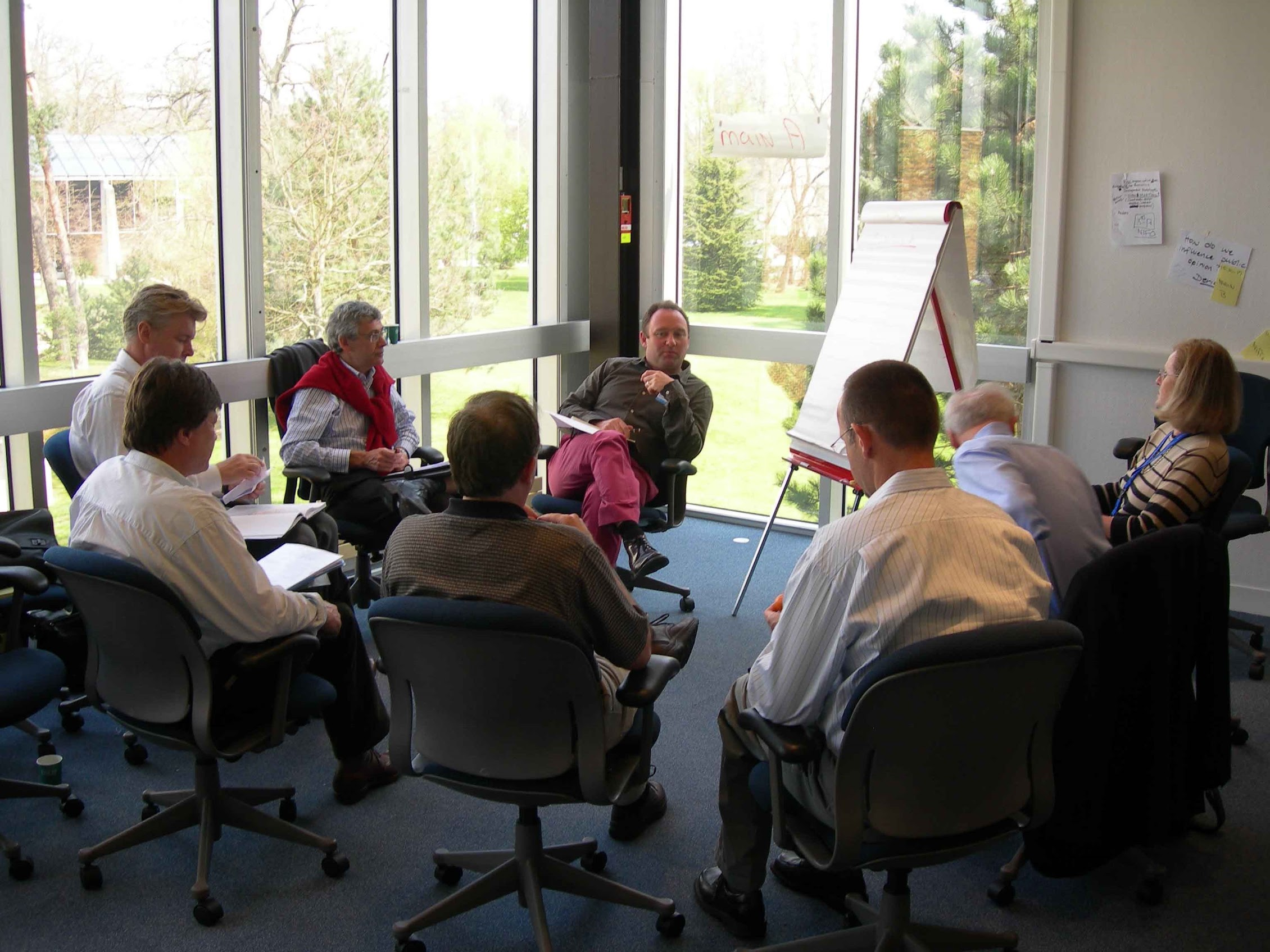
Anders Aspling recounts the early years of the GRLI.
The Start
In November 2001 the Steering Committee for the 2002 EFMD Annual Conference in Bangkok met to decide the theme and design of the meeting; which was held in relation to the Global Forum on Management Education co-hosted by EFMD and AACSB International.
As chair of this meeting – and the upcoming confernce, I opened with a question for all of us to reflect upon to start with. “What are your greatest concern for the time being – in your role as management educators and/or generally?”
Jean-Francoise Poncet, Liliana Petrella, Pierre Kletz and other members of the committee pondered the question for the opening 15 minutes of the meeting.
When we all shared our thoughts around the table, it became apparent that the prepared agenda with proposed themes for the conference, and traditional thoughts on speakers and break-out sessions, became irrelevant. The full time of the meeting passed while we discussed the challenges of the world with great engagement, energy and concern. And, we seriously wondered where the business schools of today were positioned and what they were doing in relation to the larger picture and urgent issues we debated.
We wondered about globalisation and what role we should play as individuals and educators, and about the role of our organisations in this context.
Following further discussion the theme for the 2002 Annual Conference was decided to be Global Responsibility; and our ambition was to investigate the meaning of these words, and the implications of this meaning for us, our organisations and EFMD.
The phrase “Global Responsibility” resonated with everyone involved and we set out to discover what else was being done in this new “field”, and if we were perhaps duplicating any existing work on the issue. An internet search in November of 2001 for the phrase “Global Responsibility” yielded zero results. We saw this as a strong confirmation of the relevance and urgency to address this topic.
An internet search in November of 2001 for the phrase “Global Responsibility” yielded zero results.
The conference started out with an opening session introducing the theme and followed with a number of inspirational talks on the concept. This was followed by six parallel workshops working with the proposed investigation; all with assigned reporters.
Following the report back to plenary, EFMD’s Presidents’ task force* on Global Responsibility gathered to finalise and present the Global Forum with an EFMD “Manifesto on Global Responsibility”. The final touch was made by Gerard van Schaik, Willy de Clercq and myself. Ray presented the manifesto at the opening of the Global Forum.
Preparing for Action
Later in 2002 the EFMD board decided to produce a position paper based on the Manifesto and the reports from the annual conference in Bangkok. The position paper was presented at the 2003 Deans and Directors Meeting of EFMD.
At the board meeting in January 2003, the board decided on a next stage – let us try to put these values into action. I was assigned with the task.
During 2003 the design of an action oriented project was carried out. It intended to invite engaged and dedicated organisations – schools and companies – to work on the implementation of Global Responsibility. My Swedish colleague Björn Larsson and myself designed the invitation together and used our networks to try and make it unique and as result-oriented and pragmatic as possible.
In November 2003 we signed a MoU with United Nations Global compact; agreeing that this was an opportunity where we could build on the corporate partners of UNGC and the academic members of EFMD, and achieve quality in participation from businesses and learning institutions, and join forces based on our aligned and complementary ambitions.
At the 2004 EFMD Deans and Directors meeting in Lisbon, Georg Kell, Chief Executive, UNGC, participated in the invitation to schools and companies.
In the invitation the following was stated:
“The European Foundation for Management Development, efmd, and the United Nations Global Compact have formed a unique partnership to address the question of how to best develop a new generation of globally responsible business leaders.
We are inviting the most motivated, leading and entrepreneurial minded among our members – 500 business schools and more than 1,200 companies from around the world – to take part in this initiative.
This invitation is for a 12-month hands-on action learning process, forming effective global alignments and establishing pace-setting practices for business schools and companies. Those who will become part of this initiative will take a global lead.”
The selection principle was to a large extent built on the principle presented in “Good to Great” by Jim Collins; “First Who, Then What”. Preference was given to those with a proven track record of being action oriented and engaged in these issues, and highly motivated newcomers. Diversity regarding experience, geography, industry and profile/focus was also taken into account, as was the fact that the participating organisations had to have issues of responsibility as key dimensions of their strategy and be represented by participants in decision making positions and enabled to take action. We encouraged “partner applications”, i.e. representatives from a company and its main business school partner, or representatives from a business school and a partner company.
A one-year work process
The design of the one-year co-creative learning process aimed at distinct outcomes for individuals, their organisations and for the pioneering group as a whole. The rewards for joining were to be found in the outcomes and in the process itself.
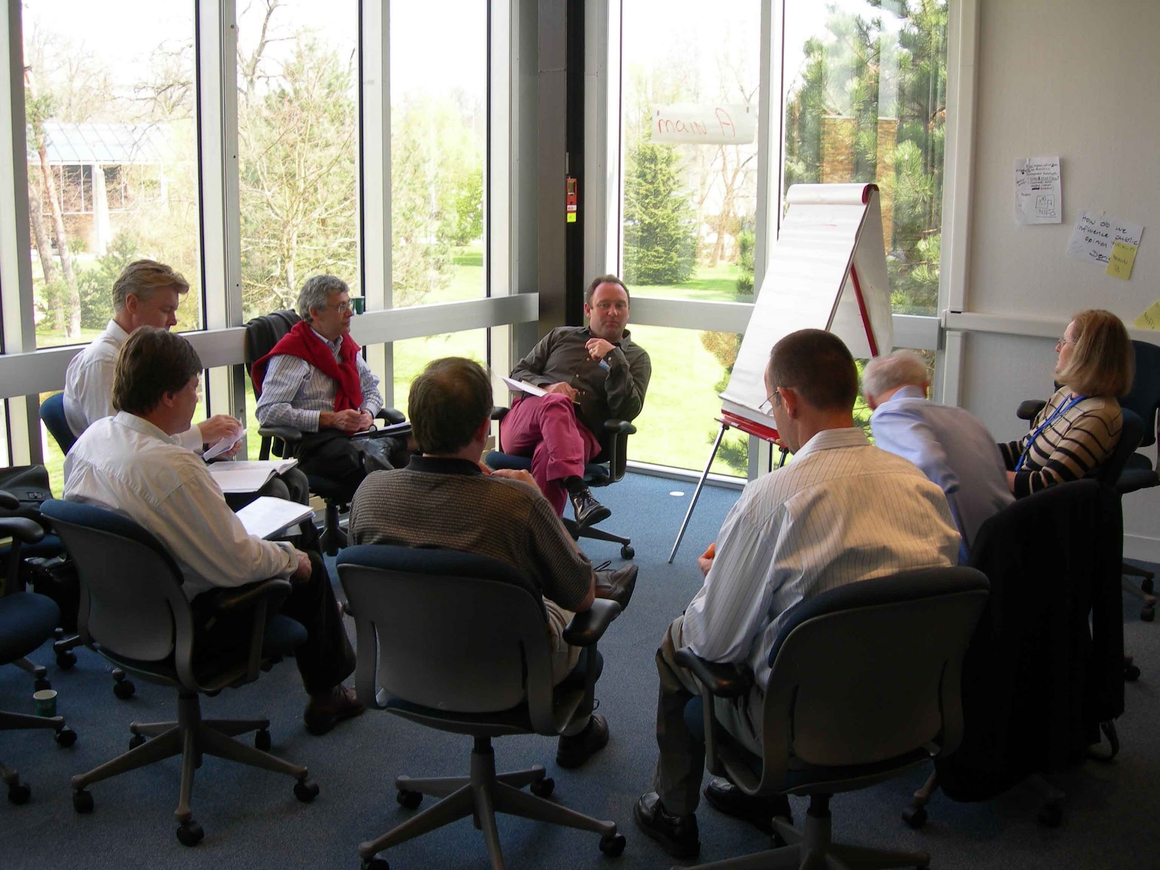
In October 2004 21 organisations gathered at Chateau de Limelette outside of Brussels for the first of six work meetings.
The flow can roughly be described in the following way, meeting by meeting:
- First meeting: Getting together, introducing each participant and organisation and their ambitions, and starting the creation of a shared vision. Laying out and agreeing on key values and principles for the initiative*. Action plans for investigating best practice.
- Second meeting: Work on each participating organisations ambition within thematic clusters shaped during the first meeting. Identified needs for further information and resources.
- Third meeting: Continued work based on prepared information and requested resources
- Fourth meeting: Prototyping final outcomes.
- Fifth meeting: Testing and practicing engagement of key stakeholders and communication.
- Sixth meeting: Finalising action plans and final deliverables.
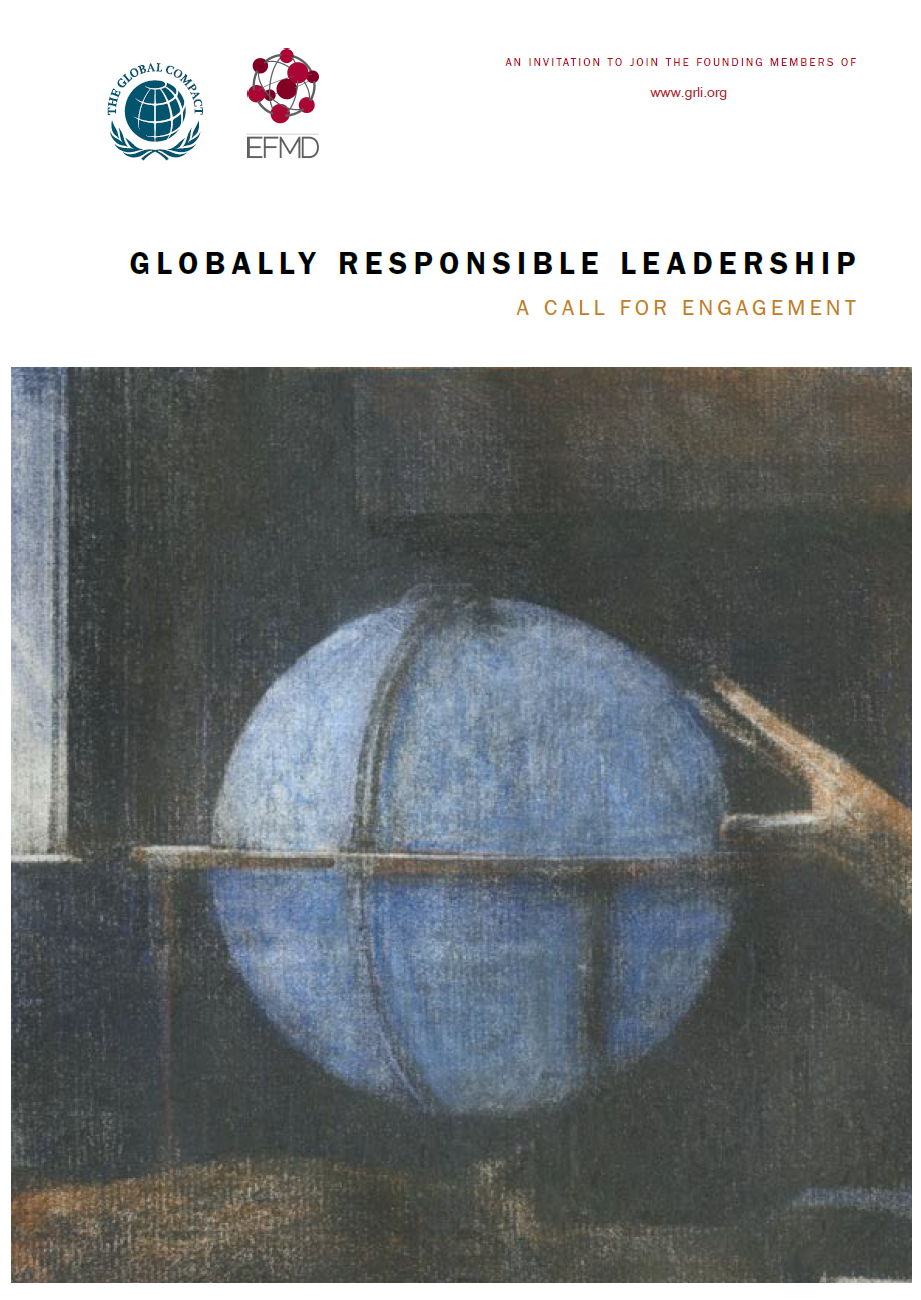
After the sixth meeting the group jointly published a ground-breaking fully co-written report – “Globally Responsible Leadership: a Call for Engagement”*. It also decided to continue the learning journey and invite others to join.
… and, the Continuation
At this stage the facilitating core team* faced a crucial challenge. The initiative was based on fundamental principles
- Action orientation
- Genuine ownership of the agenda and ambitions by the partners
- Activities driven by the challenges, interests and energy of the participants
- Self-organisation
We never had the intention to create another member serving organisation, but rather to keep a global community of action and learning vibrant and developing through the engagement of a selected group of dedicated and active partners.
The first of the continued meetings was held at INSEAD in the spring of 2004. The 21 pioneering organisations were joined by eight new partners.
In order not to risk becoming leaders, managers and organisers for a traditional pre-organised service-based organisation, the facilitating core team decided to run the meeting based on the open space principles of Harrison Owen. Harrison was assigned the task to facilitate the meeting; allowing for the core team to participate on equal terms with the rest of the participants.
The outcome of the INSEAD meeting was clear: The Globally Responsible Leadership Initiative – GRLI – was launched. It was organised as a global community of engaged partners. The coordination of the further development was assigned the core team, and the facilitation of the continued learning process was shared with active participants (especially the Oasis School of Human Relations).
“The baby was born”, as Pierre Tapie, President of ESSEC, phrased it. “Now we all need to carefully nurse it and watch it grow.” The profiling of GRLI and the preparation for its further development and wider impact began. The logo* was shaped based on “Three ellipses forming a circle as they expand – our globe. They represent I, we and all of us – from the smallest to the largest. They have the colour of a blue ocean and a clear sky”.
Final words
Since 2006 GRLI has had an impact on management education world-wide, hundreds of organisations have participated in our work – in an exciting co-creative peer-based learning process. An innovative process of implementing global responsibility in practice is both in place and still emerging.
This is the story of the early years.
This article was first published in Issue 11 of Global Responsibility (2014)