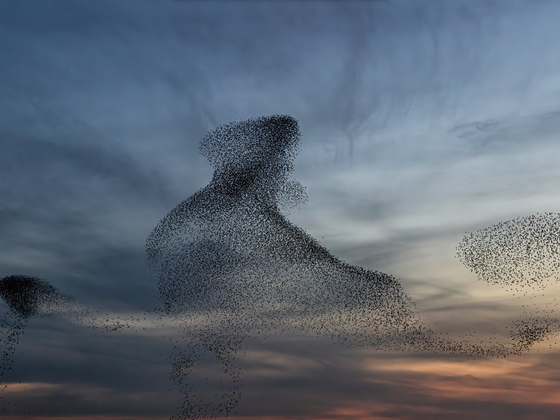
Every month, partners and associates of the GRLI gather for what we call Pulse – an online meeting where we try to connect the dots across the dispersed field of our work. “Scattered together”, we show up at EFMD and AACSB or PRME, the Academy of Management and the regional networks; Pulse is where we come back and make sense, together, of what each of us is noticing. This is a selective reflection from our June call, on 10 June 2026. As always, it is shared with participants’ sign-off, and anything that needed sanitising has been.
We were a small circle this time, and scattered even by our standards: John from a departure gate in Frankfurt, Darija from Bali well past midnight, Jeff joining from North America in a rare slot that fell at 9am rather than 5am. It was also Dia de Portugal, and Ana Conceição — with us for the first time as Vice Dean at ISCTE Business School — opened by reminding us that the day marks the death of the poet Luís de Camões. Earlier that day one of the Deans at another Portugese Business Schools pointed out that “Dia de Portugal, de Camões e das Comunidades Portuguesas” is a celebration of being “scattered together” for Portuguese communities around the world. The writing of poets like Pessoa and Camões remind us that exploration, connection, and purpose often happen across distances – something GRLI embodies remarkably well.
“Tudo vale a pena se a alma não é pequena” – Pessoa
“por mares nunca de antes navegados” – Camões
John also brought an image back from Spain, where he witnessed crowds building castells, the human towers raised shoulder on shoulder. His observation of the symbolic significance was that some might read the practice as devotion, as tradition, as physics or as teamwork, and different people had different interpretations of how this can be perceived. His point was that regardless of epistomological perspective: “a tower that only stands for those people who see it in the same way will be a very short and unstable tower.” Jeff had caught the same thread later in the call – that what holds us together is “the commitment to hold the question.”
What’s keeping us awake
Wayne Visser carried in something from a recent gathering of corporate-responsibility veterans in New York: “maybe some accountability mechanisms have a shelf life.” Decades of investment in codes, standards and frameworks, and an honest reckoning that what worked before may not work now. Which do we let go of? Which is it too early to call? Nobody in that room was self-satisfied, he noted; if anything, the urgency has grown.
The strain shows up everywhere. “Whether we think of it as an anti-ESG movement, a sustainability recession or a move to the right in politics, it’s just so much tougher right now to get heard,” Wayne said. Alexandra sees it in her classrooms at ZHAW in Switzerland, where sustainability electives are perceived as: “a trend that passed.” Researchers felt it too when the Financial Times dropped the Journal of Business Ethics from its FT50 list, which prompted her question to the room: “What kind of researchers do we want to be?”
From the United States came a longer view. Jeff Thies, who has watched California change across his lifetime, reflected that political reaction comes and goes while “the underlying imperatives just kept developing.” The work increasingly continues under new names, though — one account had a corporate inclusion programme proceeding at full strength but no longer allowed to carry its old label. And Ana voiced the reality of a stretched public institution: “we cannot simply add more initiatives or more reporting requirements or more symbolic commitments.” Her question is one every educator on the call recognised — what learning experience can we offer that students “feel it’s worth being present for”?
The labels pass; the question stays
John offered a reflection on the labels themselves, since the language of this work keeps shifting under us. CSI led to CSR and then gave way to sustainability, sustainability to ESG, and now attention and budgets are moving toward AI. It is tempting to read that as sustainability fading. He suggested reading it the other way: the labels were always going to pass. The question they each pointed at has not.
That question, as he put it, is less a standard to meet than a capacity to keep developing — the ability to notice what a situation asks of us and to act on it, with others, when the right course isn’t specified in advance. Which is also why it resists being reduced to an index or a metric, however often we are asked for one. “If responsibility can be fully specified,” he offered, “it isn’t responsibility — it’s compliance.”
He went on to make the case that this is what the AI moment sharpens rather than displaces. As more of what can be specified gets handed to a machine, the part that cannot — the judgement to act well under uncertainty — is the part that matters more, not less. Sustainability may be losing ground as a word. The capacity it was reaching for is not in any less demand.
A tension worth holding
So do we change our language to keep traction, or hold the line? Wayne shared research from a student he supervises on Appalachian organisations whose transition funding vanished: they are adapting by changing their language, and feel they have kept their integrity “because the goal hasn’t changed.” Perhaps. Darija pushed deeper, borrowing the chemist’s word homogenisation — particles reduced until uniformly distributed. If schools everywhere converge on the same vocabulary and the same offering, “what is the authentic and locally relevant but internationally connected essence that we are bringing to our students?” She remembered loving her own university as “a school of life”, which, Wayne noted, is what philosophy has always tried to be. We didn’t resolve any of this. That was rather the point.
Where collaboration becomes possible
The asks and offers from the room, for anyone looking to plug in:
- Dancing with Systems podcast. Wayne and Sally Uren (Forum for the Future) launch a six-episode first season around 2 August, exploring systems change across sectors with thirteen guests. Help spread the word when it lands.
- Technologies of Hope. Wayne’s new book, on embracing the positive side of technology without ignoring its shadow, will be published towards the end of the year.
- Leading the Exponential Enterprise. An open, in-person programme at Porto this September — details here.
- INSURE 2026 call for abstracts. The 6th Innovation for Sustainability & Regeneration conference runs 28–29 October at Universidade Católica’s Porto campus; abstracts close 25 July — call details.
- 13th RMER Conference, Leuphana University Lüneburg. Early September; extended abstracts due mid-June. GRLI has submitted two — including one sharing the emerging practice of the Impact Innovation Circles — and Jeff will be there along with other Guardians.
- PRME Global Forum, Cairo. Late June, part of a wider RME week. Alexandra will be there for the PRME Champions. If you’re attending, tell us — we ask a few people from across the partnership to anchor the GRLI presence at platform events.
- AI for Good Summit, Geneva, July. Wayne flagged the UN summit as rich territory — too late to join this year, but possibly one for GRLI partners to host a session at next year.
- Impact Innovation Circles. Two circles running, a third forming: virtual, no-cost peer groups of roughly six institutions reinventing curriculum, pedagogy and positioning, on the single condition that learning is paid forward. Updated material at grli.org/tipping-point.
- Deans & Directors Cohort, in person. Dates to be confirmed, but it looks likely that Maastricht University’s School of Business and Economics will host an in-person Cohort in spring 2027.
- Global Justice Project. John shared the World Inequality Lab’s initiative as one to watch.
The slower work continues too: in Seville John met colleagues from CLADEA, AABS, AAPBS, the Finnish association, AACSB and EFMD, as part of connecting the ecosystem more closely to itself.
Darija closed by naming what she leaves with: “gratitude for trust” — that a circle in which some of us had only just met could go this deep. Pulse meets again next month. Come with what you’re sensing, what’s keeping you awake, and one experiment worth sharing.